Legend, Politics, and Presidential Deaths
If you spend enough time at Indiana frontier sites connected to William Henry Harrison, you will eventually hear about it.
The curse.
Sometimes it’s called Tecumseh’s Curse.
Sometimes it’s called The Zero-Year Curse.
And like most great American legends, it sits right at the intersection of history, grief, coincidence, and storytelling.
The Historical Backdrop
Before we get to the creepy part, here’s the real history.

The Treaty Signed in the Parlor at grouseland
On August 21, 1805, 32 year old William Henry Harrison was the governor of the Indiana Territory. He negotiated the Treaty of Grouseland within the walls of his home. The agreement transferred land from the Miami, Delaware, Potawatomi, and Eel River tribes to the United States. The area included roughly 2.5 million acres in southern Indiana, northeastern Ohio, and parts of Illinois.
Two and a half million acres.
The treaty pushed a new boundary line from the Greenville Treaty line to the Wabash River. It formally opened the north bank of the Ohio River to white settlement. Much of this settlement had already begun illegally.
For American expansion, it was a major step forward in westward expansion. For Native nations, it was something else entirely.
The treaty included immediate payments ($4,000 at signing) and annual annuities promised to the tribes. However, historians widely agree the compensation amounted to pennies per acre. Even more troubling, later legal testimony shows that some reserved lands protected in the treaty were never properly negotiated for. They were also not paid for before being transferred to non-Indians. Across the 19th century, corruption and administrative failures often prevented annuity payments from ever fully reaching tribal communities.
On paper, the treaty also included assurances of sovereignty. Article IV recognized certain tribes as joint owners of unceded lands along the Wabash River. It pledged that the United States would not purchase additional land without the consent of all parties.
But paper promises proved fragile.
As settlers poured in, pressure mounted. Additional land cessions followed in the decades ahead. Federal legal doctrine changed significantly. In 1831, the Supreme Court redefined tribes as “domestic dependent nations.” This decision narrowed the scope of recognized sovereignty.

Perhaps most significantly, the Treaty of Grouseland intensified resistance. Shawnee leader Tecumseh argued that no single tribe had the authority to sell commonly held Indigenous land. Repeated treaties like this one caused a lot of frustration. This frustration strengthened his confederacy. It directly contributed to the rising tensions that culminated in the Battle of Tippecanoe and the War of 1812.
The Treaty of Grouseland was not just a land deal. It was a turning point in westward expansion. This dramatically shrank Native-controlled territory in the Old Northwest. It also reshaped the future of the region.
I recently visited Grouseland. It’s one thing to read about westward expansion in a textbook. It’s another to stand in the house where 2.5 million acres changed hands. To look out the window and see the land the US acquired with that treaty.
In the early 1800s, Shawnee leader Tecumseh took significant steps. His brother Tenskwatawa, known as “The Prophet”, joined him in this effort. They worked to build a Native American confederation. Their goal was to resist U.S. expansion into tribal lands.

Tensions escalated.
In 1811, while Tecumseh was away seeking broader tribal alliances, Harrison led U.S. forces against Prophetstown (near present-day Battle Ground, Indiana). The clash became known as the Battle of Tippecanoe. Harrison claimed victory. Tecumseh’s confederation was weakened. Westward expansion accelerated. It was a pivotal moment — and one that carried enormous consequences for Native nations.

So Where Does the “Curse” Come In?
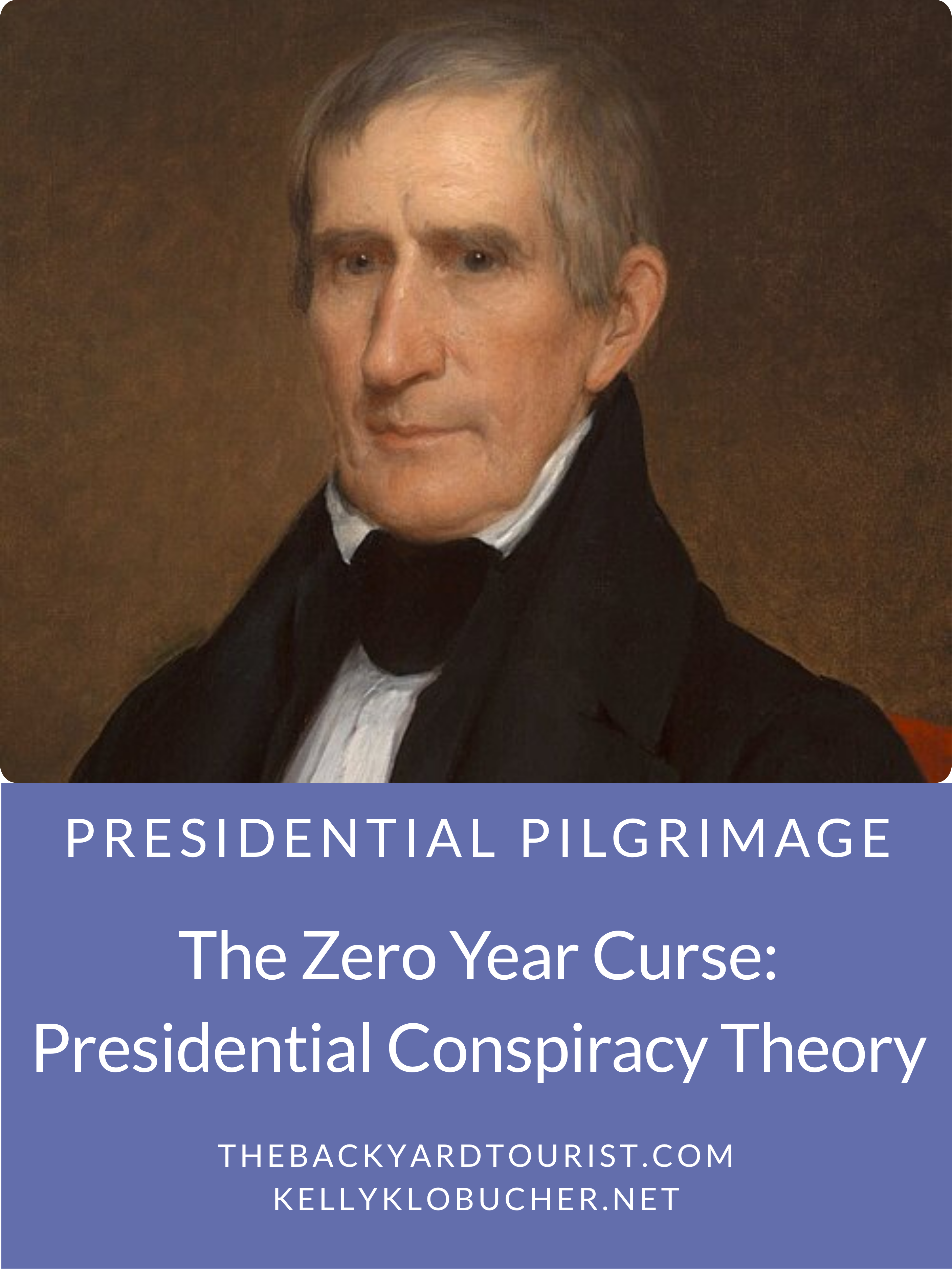
The legend says that either Tecumseh or Tenskwatawa placed a curse on Harrison — and on future U.S. presidents elected in years ending in zero. According to the story, any president elected in a “zero year” would die in office. And then something eerie happened.
Here’s the pattern:
- 1840 – William Henry Harrison → died in office (1841)
- 1860 – Abraham Lincoln → assassinated (1865)
- 1880 – James A. Garfield → assassinated (1881)
- 1900 – William McKinley → assassinated (1901)
- 1920 – Warren G. Harding → died in office (1923)
- 1940 – Franklin D. Roosevelt → died in office (1945)
- 1960 – John F. Kennedy → assassinated (1963)
Seven consecutive presidents.
Seven deaths.
If you’re a Gen X history nerd listening to a podcast on a two-lane highway, that’s the moment you turn the volume up.
And Then…
In 1980, Ronald Reagan was elected. He was shot in 1981 — but survived.
In 2000, George W. Bush was elected. He survived his presidency. The streak appeared to be broken.
History vs. Legend
There is no documented historical evidence that Tecumseh actually issued such a curse. Most historians consider it folklore — a retroactive pattern people noticed after multiple presidential deaths.
But here’s why the story persists. Because the real history behind it is heavy.
The conflict between Harrison and Tecumseh wasn’t mythical. It was about land, sovereignty, broken treaties, and the expansion of a young nation at the expense of Native peoples. The “curse” legend may be less about magic and more about the long shadow of those early frontier decisions.
You stand in a place like Grouseland and think about treaties signed on the old desk in the corner. Then, trace the effects of those treaties. Consider the way they were broken later in US history. It doesn’t feel supernatural. It feels consequential.
Why I Love Presidential Sites (and Legends Like This)
Visiting these places reminds me that American history isn’t tidy.
It’s layered.
Complicated.
Human.
Sometimes, you drive on a quiet stretch of road near the Wabash River. You have a podcast queued up about early US politics. Then, you realize that stories like Tecumseh’s Curse are less about ghosts. They are more about memory.