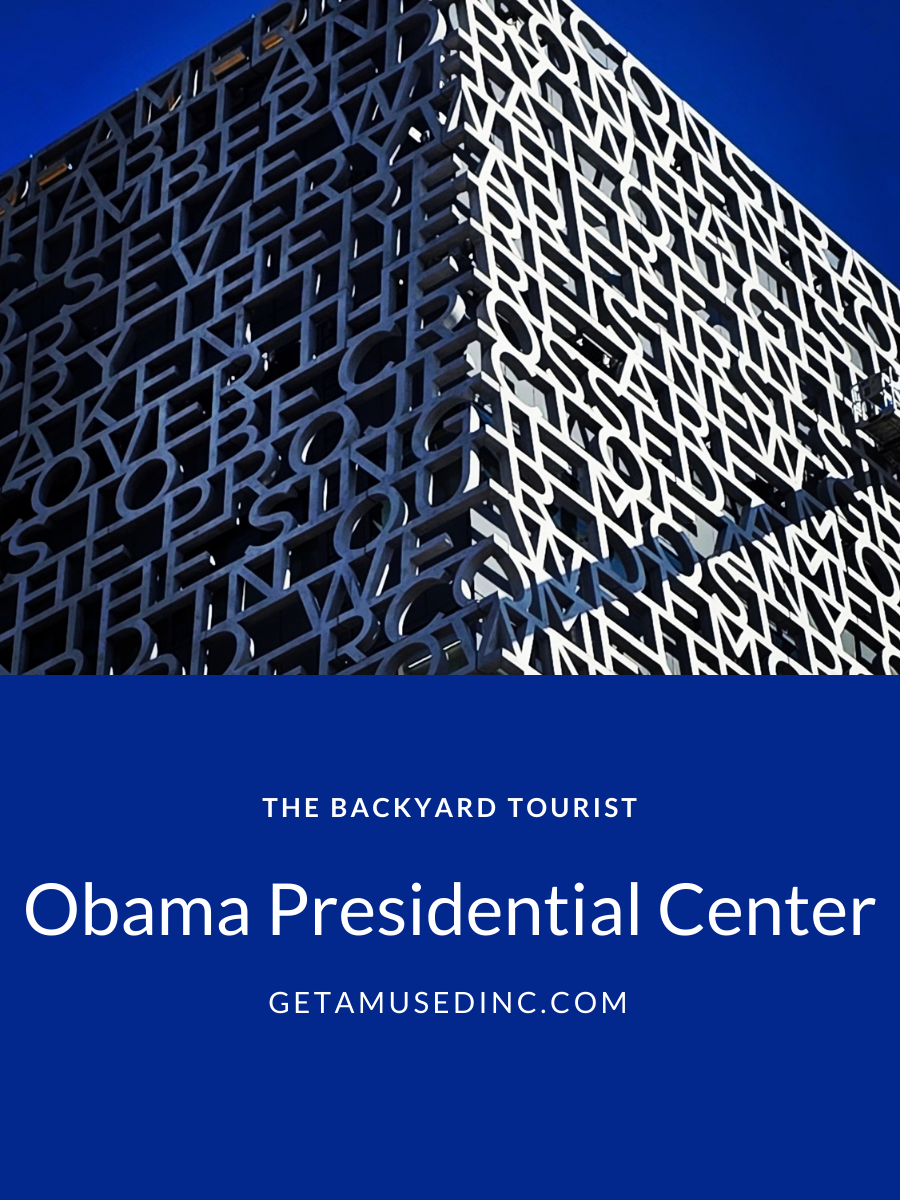
The architectural meaning of the Obama Presidential Center (scheduled to open in June 2026) revolves around “collective action.” It also emphasizes community engagement and people working together in grassroots efforts to better the world around them. The Center is designed by Tod Williams and Billie Tsien. The museum campus shifts the traditional presidential library model. It transitions from the model of “story-telling,” or preserving the past and lauding the achievements of a former President. It is instead to a place of “story-making,” empowering future leaders. A place of action and new ideas.

The Museum Tower
The most prominent structure on the campus is a 225-foot museum tower faced in granite. The tower’s tapering, four-sided form is inspired by the image of four hands coming together. This idea signifies that “many hands shape a place”. It emphasizes that collective effort is required for social progress. Architects designed each of the four facades to be slightly different. This design choice illustrates how diverse individual efforts merge into a single “collective action”. The structure’s height and upward-tapering angles are meant to evoke grassroots momentum. They symbolize the idea of ordinary people having the power to do make changes together.

Photo by Kelly Klobucher This photo was taken while the final letters were being placed. Here is a news video of the letters being installed a few days before this photo was taken.
The nineteen acre campus is designed as a public park, blending the buildings into the existing Jackson Park landscape. The overall campus layout is designed to be a “lantern of light.” It serves as a beacon of connection and hope. Most of the campus is public-facing. It includes a sledding hill inspired by Michelle Obama, a public library branch, and a community garden. These elements reinforce the theme of local civic engagement.
Architecturally, the center deviates significantly from past presidential libraries by not housing physical archives. The “library” building serves as a community resource. It offers digital labs and job training spaces. It prioritizes modern accessibility over physical storage as the first president to digitize all White House records.
To protect sensitive historical artifacts from sunlight, the building features relatively few windows. The windows that do exist are placed strategically to frame specific views of Chicago’s South and West sides.
A must see highlight in the tower is a stained-glass installation “Uprising of the Sun” by Julie Mehretu. The abstract work spans 83 feet tall. It uses warm colors and shard-like shapes. These elements reflect historical events and illuminate the museum’s interior.
The Landscape
Below are artists renderings and maps of the plans for the site. These can be found with greater detail and narrative on the Obama Foundation website.
*I do plan to visit and take my own photos once the site opens in June.

The Ann Dunham Water Garden is an intimate “Water Terrace” located near the Museum’s north entrance. Named after President Obama’s mother, the garden is designed as a space for reflection and community engagement. The garden honors her belief in human dignity and global development. President Obama envisioned it as a place where his mother would have enjoyed sitting on a bench. She would have watched children play there.

The centerpiece of the garden is a site-specific, two-part water sculpture by Maya Lin. It is titled Seeing Through the Universe. Lin focused on the water terrace. The broader nineteen-acre campus, designed by Michael Van Valkenburgh Associates, integrates her work into a larger ecological plan. This includes a Wetland Walk that captures and reuses storm water for irrigation. The garden features stone seating blocks that can accommodate small gatherings or classes. This setup reinforces the Center’s mission of civic engagement.


Suggested Reading/Listening to enhance your visit:
The Obama Presidential Library is set to open in June of 2026. In the meantime, you can learn more about the legacy of President Obama. Read or listen to these books and podcasts during your road trip to visit museums!
- Brene Brown Podcast: Dare to Lead
- Barack Obama: A Kid’s Book About Becoming the First Black President of the United States Great if you are visiting with kids.
- “A Promised Land” by Barack Obama (2020): It is a deeply personal, candid memoir. It covers his journey to the presidency and his first term.
- “Dreams from My Father: A Story of Race and Inheritance” by Barack Obama (1995): An earlier memoir. It details his early life, family, and search for identity.
- “Obama: An Intimate Portrait” by Pete Souza (2017): This book is a photojournalism project by his White House photographer. It offers a behind-the-scenes look at his presidency.
- “Of Thee I Sing: A Letter to My Daughters” by Barack Obama (2010): A children’s book reflecting on American history and values.
Other things to do while you are in the area:
- Museum of Science and Industry (MSI): This is one of the largest science museums in the US. It features the Apollo 8 spacecraft. It also has a coal mine experience, weather exhibits, a huge train set, and so much more!
- DuSable Black History Museum and Education Center: Dedicated to the history and culture of Africans and Americans of African descent.
- Frank Lloyd Wright Robie House: A UNESCO World Heritage site and masterpiece of Prairie-style architecture.
- University of Chicago Campus: Explore the Gothic-style campus, including the Rockefeller Memorial Chapel and the Smart Museum of Art.
- Garden of the Phoenix: A peaceful Japanese garden located in Jackson Park.
- Barack Obama’s Chicago Home: View the exterior of the former President’s residence in the Kenwood area. This is a private residence. It is NOT a house museum. Depending on security, there are times that the house is not visible and the neighborhood not accessible.
- Promontory Point: A man-made peninsula offering stunning views of the Chicago skyline.
Shopping & Dining
- Bookstores: Visit 57th Street Books or the Seminary Co-op Bookstores.
- Dining: Explore diverse, multi-ethnic restaurants along 53rd and 55th Streets.
- Local Shops: Browse specialized shops like Hyde Park Records.
Leave a Reply