There are places you expect to find.
And then there are places you have to go looking for.
To reach Kaskaskia, you don’t stay in Illinois.
You cross into Missouri.
Because the first capital of Illinois is no longer fully in Illinois.
And that tells you almost everything you need to know.
A Capital Lost to the River
Kaskaskia was once the center of power in the state.
In 1818, when Illinois became a state, this small French colonial village along the Mississippi River was chosen as its first capital. Government met here. Decisions were made here. The foundation of the state was laid here.
Despite its small size today, Kaskaskia was once the political center of Illinois and the site of several decisions that shaped the state’s future. As the capital of the Illinois Territory from 1809 to 1818, territorial lawmakers met here to establish the legal framework for the growing frontier. In 1818, delegates gathered in Kaskaskia to draft and adopt Illinois’ first state constitution, paving the way for Illinois to become the 21st state in the Union. The town also hosted Illinois’ first General Assembly and the swearing-in of Governor Shadrach Bond, the state’s first governor. Earlier, in 1778, George Rogers Clark’s capture of Kaskaskia during the American Revolution secured the Illinois Country for the United States, helping establish American claims to the Northwest Territory. Few places in Illinois can claim to have played such an important role in both the nation’s founding and the creation of the state itself.
And then the river moved.
History didn’t move.
The land did.
Kaskaskia’s fate was forever changed by the Great Flood of 1881. Years of deforestation along the Mississippi River had increased erosion and altered the river’s flow, making it more prone to changing course. During the flood, the Mississippi broke through a narrow strip of land and captured the nearby Kaskaskia River channel, permanently shifting its course. The change left Kaskaskia physically connected to Missouri while legally remaining part of Illinois. Over time, flooding and erosion destroyed much of the original town, creating one of the most fascinating geographic oddities in the United States.
The Statehouse That Isn’t There
Unlike Vandalia or Springfield, you won’t find a preserved capitol building here.
The original statehouse is gone.
Flooding, time, and the shifting river erased much of the built environment that once defined this place. What remains is quieter—less tangible, but in some ways more powerful.
Because here, you’re not walking through rooms.
You’re standing in absence.

What Still Stands
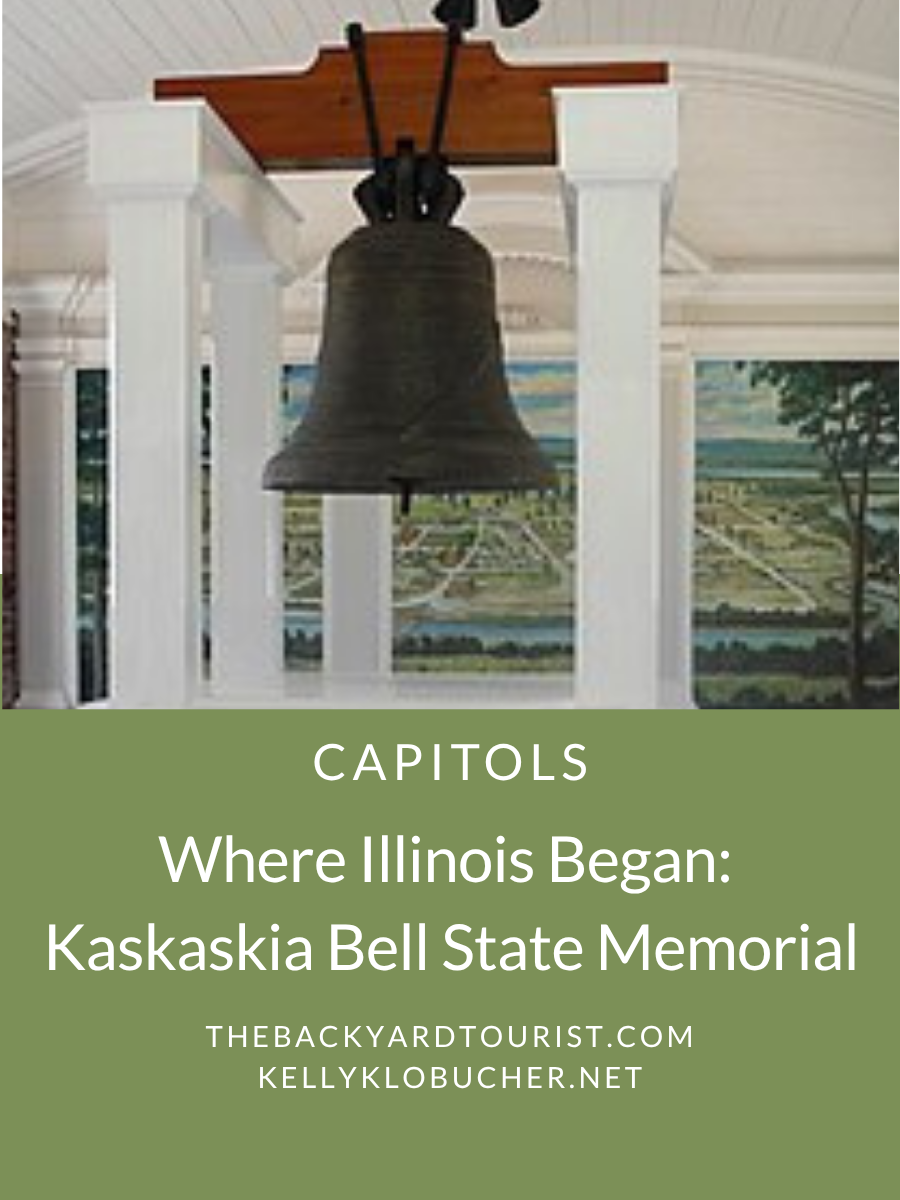
The most prominent site today is the Kaskaskia Bell State Memorial, home to a bell said to have been given by King Louis XV of France—often called the “Liberty Bell of the West.”
Nearby, the Immaculate Conception Church remains a physical link to the village’s earlier life—French colonial roots layered beneath American statehood.
But even these structures feel secondary to the landscape itself.

When the River Rewrote the Map
The Mississippi River has never been interested in staying put.
For years, it had been quietly shifting—eroding one bank, building another, tracing a long, looping path around Kaskaskia. And then, in 1881, during a major flood, it did what rivers like this eventually do.
It chose a shorter route.
The water broke through a narrow bend, abandoned its old channel, and carved a new one—leaving Kaskaskia on the opposite side of the river almost overnight.
The capital didn’t move.
The landscape did.
And standing there now, it’s hard not to see how something as powerful—and as indifferent—as a river can quietly undo the permanence we tend to assign to place.
Why This Place Stays With You
Kaskaskia requires imagination.
There are no grand interpretive centers. No reconstructed streets filled with activity. No clear visual of what once stood here.
Instead, you’re asked to reconcile what you know with what you see:
A quiet stretch of land.
A handful of structures.
A river that decided otherwise.
It’s a different kind of historic experience—one that reminds you how fragile place can be.
The Geography of Power
We often think of capitals as fixed.
Permanent.
Intentional.
Enduring.
Kaskaskia challenges that idea.
It reminds us that early statehood was fluid—not just politically, but physically. That geography itself could reshape governance. That the location of power was, at times, as unstable as the frontier surrounding it.
Road Trip Notes
- You will approach from Missouri—plan accordingly
- Time: 45 minutes to an hour
- Coffee: Stop before you arrive—this is a quiet, rural setting
- Photo tip: Capture the river landscape—it tells the story
Final Thought
We tend to anchor history in buildings.
Capitols.
Homes.
Monuments.
But Kaskaskia reminds us that history is also shaped by forces we don’t control.
Water.
Land.
Time.
The first capital of Illinois doesn’t stand in brick and mortar anymore.
It exists in memory, in geography, and in the understanding that even the most important places are not guaranteed permanence. Take the long way.
Cross the state line.
Stand where Illinois
Leave a Reply