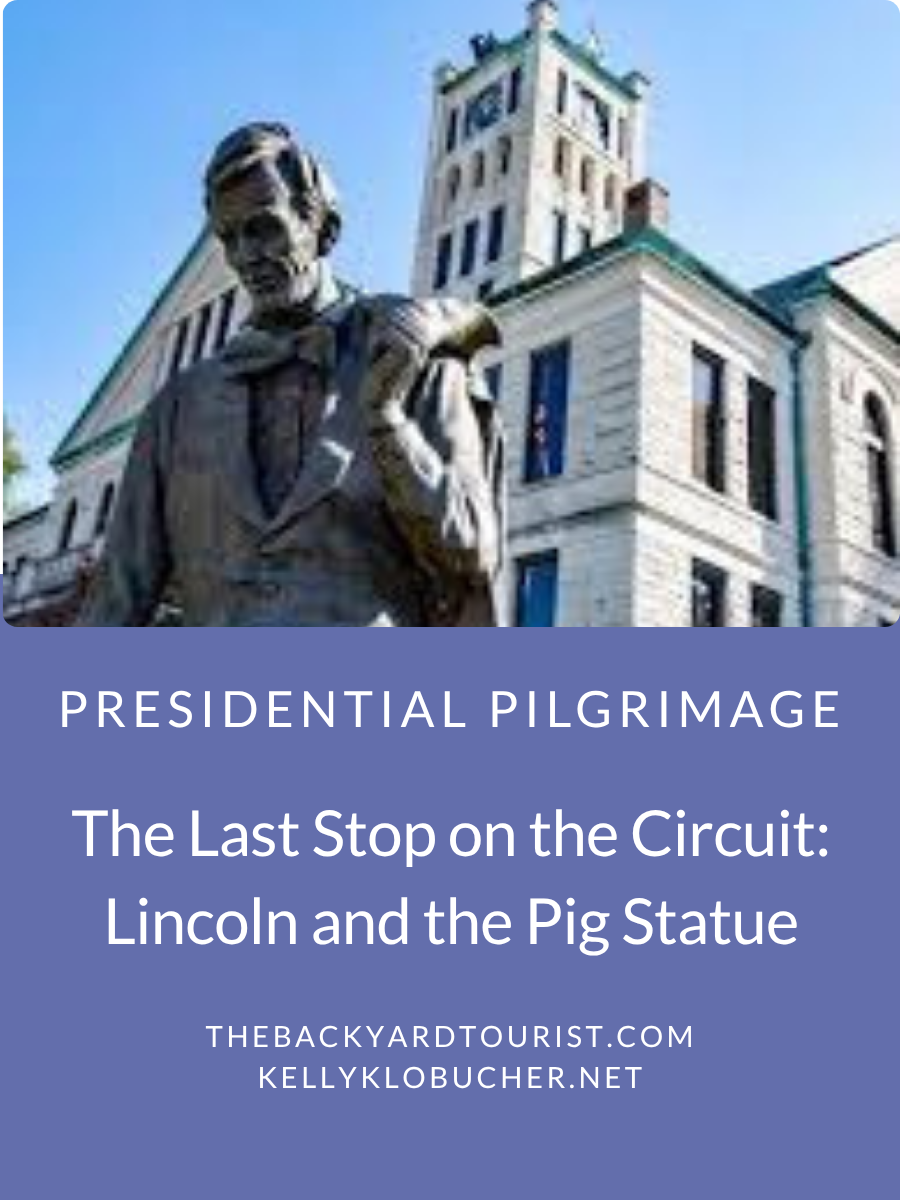
On the square in Taylorville, just outside the Christian County Courthouse, stands one of the more unexpected—and quietly revealing—Lincoln sites you’ll find.
The statue is called “The Last Stop.”
And like most good stories on the Lincoln trail, it’s both grounded in history and shaped by the way communities remember it.

A Stop on the Eighth Judicial Circuit
Before he was president, Abraham Lincoln spent years traveling the Eighth Judicial Circuit, riding from town to town to practice law.
Taylorville marked one of those stops.
Not a grand destination. Not a defining speech.
Just part of the work.
And that’s what this statue honors—the rhythm of that life. The movement. The ordinary days that built a career.
The Story Beneath the Courthouse
The scene itself comes from a local story tied to Lincoln’s time here in the 1840s.
At the time, the courthouse wasn’t the solid, imposing structure you see today. It was a small frame building, raised slightly off the ground. Practical. Functional. Very much of its time.
And not entirely sealed.
Which meant that while court was in session, pigs could—and apparently did—wander underneath.
At one point, the noise became too much. The squealing rose up through the floorboards, interrupting proceedings. Lincoln, with his characteristic dry humor, is said to have asked the judge for a “writ of quietus”—a tongue-in-cheek legal request to restore order.
It’s a small moment.
But it’s also a perfect one.
The Statue Itself
“The Last Stop,” sculpted by John McClarey, captures that blend of humor and humanity. Dedicated on May 28, 1995, and gifted by the Monte Siegrist family, the bronze doesn’t elevate Lincoln beyond reach.
It places him right in the middle of the moment.
Grounded. Present. Slightly amused.
Exactly where he would have been.
Why This Story Works
There are many ways to interpret Lincoln.
Statesman.
Leader.
Symbol.
But stories like this remind you that he was also a working attorney navigating imperfect conditions—courtrooms that weren’t always quiet, structures that weren’t always finished, and days that didn’t always go as planned.
It’s easy to admire greatness.
It’s harder—and more meaningful—to understand the everyday reality that precedes it.

A Detail Worth Seeking Out
That original courthouse—the small frame building that allowed pigs to wander underneath—still exists. It has been relocated to the east side of town and is preserved by the local historical society.
It’s worth finding.
Because once you see it, the story becomes less anecdote and more context.
Road Trip Notes
- Easy stop on any central Illinois route
- Coffee: Walk the square and choose local
- Time: 20–30 minutes, longer if you visit the historic courthouse site
- Photo tip: Frame Lincoln and the courthouse together—it ties the story to place
Final Thought
Not every Lincoln story is monumental.
Some are quieter than that.
More human.
A little unexpected.
A courtroom.
A disruption.
A well-timed remark.
And a reminder that history isn’t always shaped in silence.
Take the long way.
Stop at the square.
Listen for the stories beneath the floorboards.
Leave a Reply