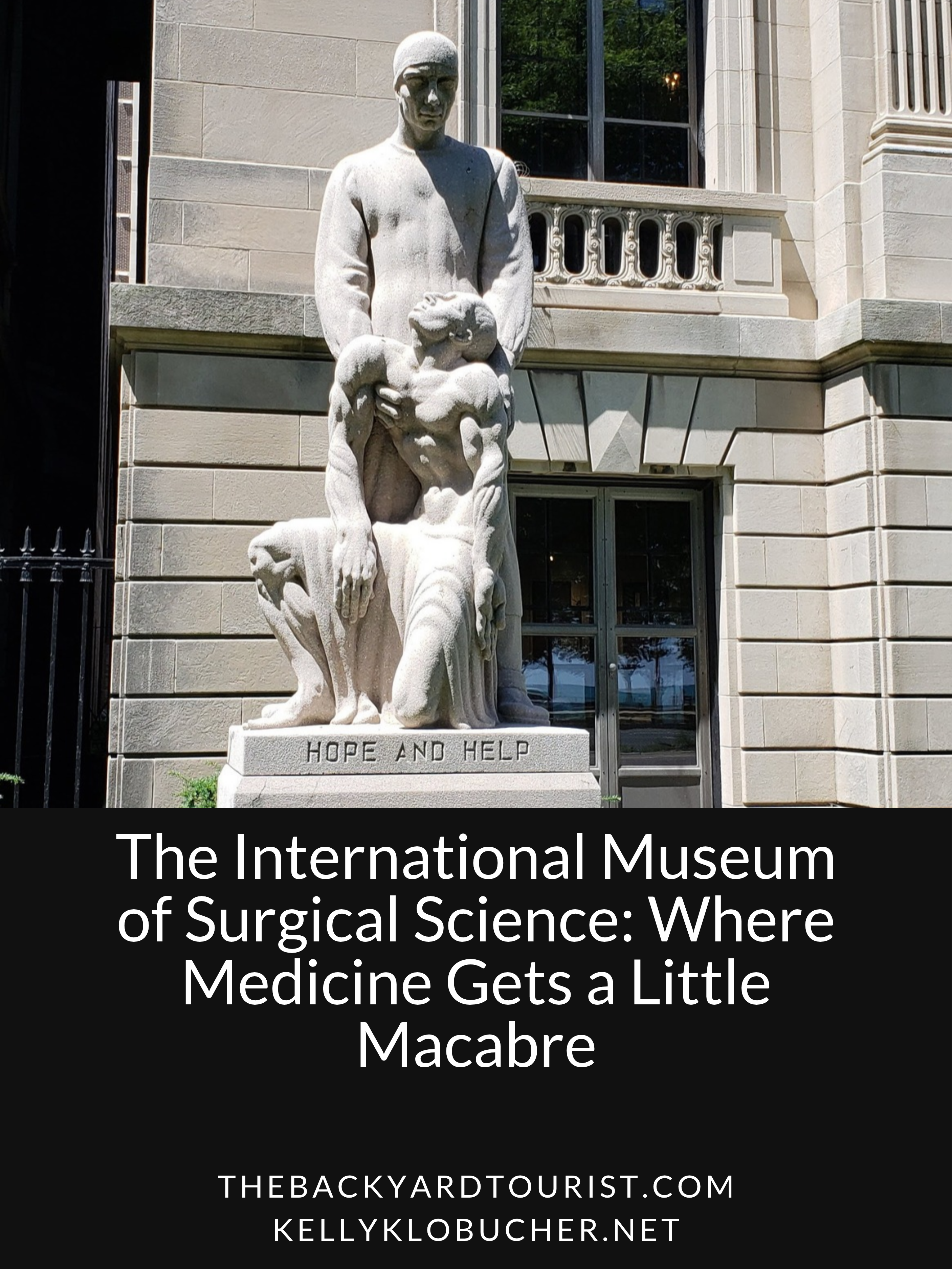
There are museums where you expect to learn about art, history, transportation or natural science.
And then there is the International Museum of Surgical Science in Chicago, where you can contemplate a 500-year-old amputation saw, ancient skulls with holes drilled into them, an iron lung, early X-rays, surgical instruments and the history of anesthesia—all inside an elegant lakefront mansion.
It is fascinating.
It is occasionally unsettling.
And if you are looking for a Chicago museum that feels a little different from the usual museum circuit, this one belongs on your list.
Located at 1524 N. Lake Shore Drive, the International Museum of Surgical Science occupies a 1917 Gold Coast mansion overlooking Lake Michigan. The building was designed to resemble the Petit Trianon at Versailles and was originally built as a wedding present for Eleanor Robinson Countiss. The mansion remained in the Countiss family until it was acquired by the International College of Surgeons and eventually opened as a museum in 1954.
Today, more than 10,000 square feet of galleries tell the story of surgery and medicine across centuries and around the world. The museum describes itself as North America’s only museum devoted specifically to surgery.
And honestly, the building is part of the experience.

A Museum Born From a Surgeon’s Vision
The museum grew out of the vision of Dr. Max Thorek, founder of the International College of Surgeons.
Thorek established the organization in 1935 with the goal of encouraging the exchange of surgical knowledge around the world. The museum was initially conceived as a kind of Hall of Fame and repository for significant surgical instruments, manuscripts, artwork and other objects related to the history of medicine.
As donations arrived from surgeons, collectors and national sections of the International College of Surgeons, the collection grew.
Eventually, it needed a home.
The Countiss mansion became that home.
The museum opened to the public on September 9, 1954.
That international perspective is still evident throughout the museum. Galleries explore medical history from different countries and cultures, while other exhibits follow the development of particular medical specialties or technologies.
It isn’t simply a collection of old medical equipment.
It is a history of how humans have tried to understand—and repair—the human body.

The Hall of Immortals
One of the first rooms you encounter is also one of the most dramatic.
The Hall of Immortals contains sculptures honoring important figures in the history of medicine and science.
Look closely at the names.
You’ll encounter people whose ideas helped transform medicine, including Ignaz Semmelweis, Louis Pasteur and Joseph Lister.
Their stories are particularly important because modern medicine can make today’s practices seem inevitable.
They weren’t.
The idea that doctors should wash their hands before treating patients was once controversial. Germ theory was not immediately accepted. Sterilization and antiseptic surgery had to be demonstrated, debated and adopted.
The museum does something I particularly appreciate: it allows you to see medical progress as a process rather than a straight line.
Medicine is full of discoveries, mistakes, resistance, experimentation and eventually—sometimes—breakthroughs.

The Hall of Murals
Then there is the Hall of Murals, where medical history becomes art.
Twelve large mural panels, painted in 1953 by Italian artist Gregorio Calvi di Bergolo, depict the development of surgery through the ages. The museum commissioned the murals as part of the original development of its collection.
And this is where the museum becomes much more than a collection of instruments.
Throughout the building, paintings and sculptures interpret medicine alongside the artifacts.
There is something wonderfully old-fashioned about the idea that a museum about surgery should also be an art museum.
But it makes sense.
For centuries, artists and physicians have shared an interest in the human body. Medical illustration helped physicians understand anatomy, while artists studied anatomy to better understand the human form.
Here, those traditions overlap.

And Then There Are the Instruments
This is probably where your reaction will depend on your personal tolerance for medical history.
The museum has more than 7,000 medical artifacts spanning centuries of worldwide medical history. Among the collection highlights are an Austrian amputation saw dating to approximately 1500, early X-rays, the Lindbergh perfusion pump and a collection of ancient Peruvian skulls showing evidence of trephination.
Some objects are beautiful.
Some are ingenious.
Some make you very glad to live in the twenty-first century.
The collection demonstrates just how inventive—and sometimes desperate—people have been when faced with illness and injury.
Before modern anesthesia, antiseptics, antibiotics and sophisticated surgical technology, surgery was a very different proposition.
Pain wasn’t simply something to manage.
It was part of the procedure.
And infection could be as dangerous as the original injury.

The History of Pain
One of the museum’s recurring themes is the evolution of anesthesia.
That history is fascinating because anesthesia changed what surgeons could attempt.
Before effective anesthesia, speed mattered enormously.
Imagine needing surgery and knowing that the surgeon’s goal was essentially to finish as quickly as possible.
The museum’s collection includes anesthesia equipment and inhalation masks dating from the Civil War era through approximately 1900, providing a tangible connection to the development of pain management.
Suddenly, surgery could become more deliberate.
More complicated procedures became possible.
The relationship between surgeon and patient changed.
A simple technological development fundamentally changed medicine.
That’s the kind of story this museum tells particularly well.

The Iron Lung
The museum also tells the story of polio through an iron lung—one of the earliest objects donated to the collection.
Standing in front of one is a powerful reminder of how frightening a disease can become when you encounter the technology created to keep its victims alive.
It is also a reminder of how dramatically medicine can change within a single lifetime.
The iron lung is no longer the symbol of an everyday medical crisis it once was.
Instead, it has become an artifact of a particular moment in medical history.
That transition—from technology in use to museum object—is one of the reasons medical museums matter.

Looking Inside the Human Body
The museum’s collections also explore anatomy, pathology, diagnostic technology and medical imaging.
The development of X-rays was revolutionary because physicians could suddenly see inside the human body without cutting it open.
But the museum also reminds us that new technologies don’t arrive with an instruction manual for their risks.
One particularly intriguing artifact is an early twentieth-century X-ray shoe-fitting machine.
Yes, people once used X-rays to look at their feet while trying on shoes.
It is a terrific example of how quickly a revolutionary technology can become commercialized—and how little people sometimes understand the risks of something new.
Today, that seems astonishing.
That’s part of what makes it such a good museum object.

The Ancient Skull That Stops You in Your Tracks
One of the museum’s more unsettling collections involves trephination—the practice of cutting or drilling an opening into the skull.
The museum has ancient Peruvian skulls showing evidence of the procedure.
Standing there, it is difficult not to wonder what the person experienced, why the procedure was performed and how someone thousands of years ago came to understand that manipulating the skull could sometimes be part of treating injury or illness.
It is easy to look at ancient medical practices and dismiss them as primitive.
The better question is: What did these people know that led them to try this?
That is one of the questions I like most about museums of medicine.
They force us to reconsider what we think we know about the past.

A Museum About People, Not Just Procedures
For me, the most interesting thing about the International Museum of Surgical Science isn’t actually the instruments.
It is the human story behind them.
Every object represents a problem someone was trying to solve.
Someone was in pain.
Someone was sick.
Someone was injured.
Someone was trying to save a life.
Someone was experimenting with an idea that might—or might not—work.
And someone else eventually learned from it.
The history of medicine is therefore also a history of human curiosity, persistence and occasionally spectacular failure.
That makes the museum surprisingly appropriate for the Backyard Tourist.
Because this is exactly the kind of place I love discovering: a museum that tells a very specific story but ends up telling a much bigger one.

And Yes, It’s a Little Creepy
Let’s not pretend otherwise.
There are skulls. There are surgical instruments. There are illustrations of procedures that are difficult to imagine undergoing. There is an old mansion.
And there is enough medical history to make you very grateful for modern healthcare.
But the museum doesn’t exist simply to shock visitors.
Its mission is educational: to help visitors understand the history, development and advances of surgery and related areas of medicine. Its collections and exhibitions put those developments into historical context.
That’s an important distinction.
There is a difference between “look how horrifying this is” and “look how far we’ve come.”
The latter is what makes the museum worthwhile.
Look Up From the Medicine
Don’t make the mistake of spending your entire visit staring into display cases.
Look at the building.
The original floors and walls remain in portions of the first and second floors, and the historic library is particularly significant. The Thorek Manuscripts and Rare Books Collection contains more than 1,000 rare texts spanning more than 1,200 years of history.
There are also more than 600 paintings, prints and sculptures in the museum’s collections.
In other words, you are visiting a historic house, an art collection and a medical museum at the same time.
That’s a pretty good Chicago combination.
Why the International Museum of Surgical Science Belongs on Your Chicago List
Chicago has no shortage of world-class museums.
But sometimes the museums I remember most are the ones that make me stop and say:
“Wait. Chicago has a museum about WHAT?”
The International Museum of Surgical Science is one of those places.
It is unusual without being gimmicky. It’s scholarly without being stuffy. It’s beautiful in places and unsettling in others.
And it tells a story that affects every one of us.
Because every human being who has ever lived has had a body.
We’ve all experienced pain.
We’ve all gotten sick.
And at some point, many of us will depend upon the accumulated knowledge of thousands of years of medical experimentation, discovery and science.
That makes the history of surgery much more than a collection of old instruments.
It’s our history.
The International Museum of Surgical Science
1524 N. Lake Shore Drive
Chicago, Illinois
The museum is currently open Monday–Friday, 9:30 a.m.–5 p.m., and Saturday–Sunday, 10 a.m.–5 p.m. Adult admission is currently $25, with discounted admission for seniors, students, educators and military members. Check the museum’s website before visiting for current hours, admission and special programming.
Leave a Reply