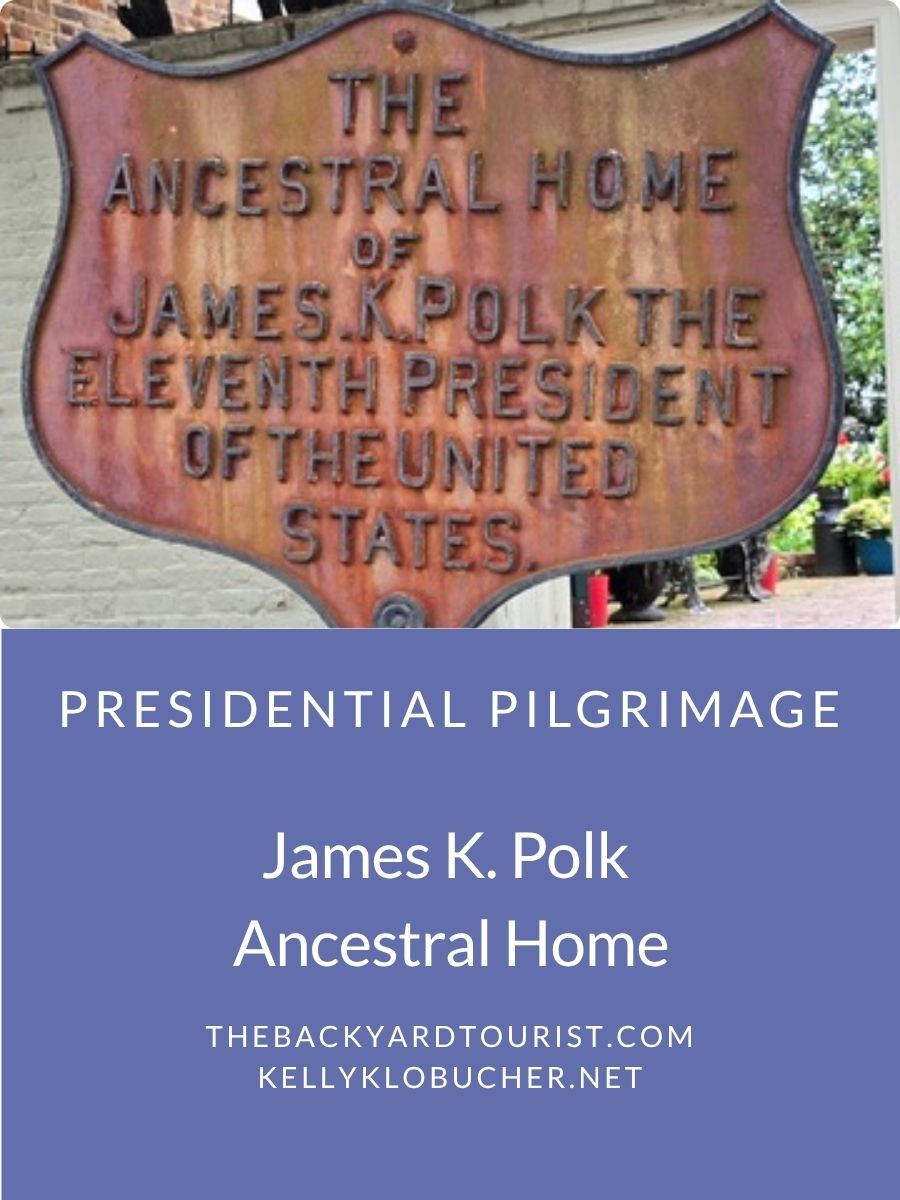
Columbia, Tennessee

The James K. Polk Home & Museum in Columbia, Tennessee, is the only surviving residence of the 11th President of the United States. While Polk was born in North Carolina and lived much of his political life in Nashville and Washington, it was in Columbia that he matured from an ambitious young lawyer into one of the most influential—and controversial—presidents in American history. Today, the house offers visitors an intimate look at the early life of a man who transformed the map of the United States.

Unlike many presidential homes, the Polk House was not built as a presidential residence.
The two-story Federal-style home was constructed in 1816 by James Polk’s father, Samuel Polk, after the family relocated from North Carolina to Middle Tennessee. The Polks were among thousands of settlers seeking new opportunities on the expanding American frontier.

James K. Polk lived here as a young adult while studying law, beginning his legal practice, and launching the political career that would eventually lead him to the White House.
Today, the home serves as a museum dedicated to interpreting Polk’s life, presidency, and the dramatic era of American expansion.
Preservation in Action
The home was originally a private family residence. Its preservation, however, came through the efforts of citizens rather than the federal government.
In 1924, the newly formed James K. Polk Memorial Association purchased the property after recognizing that it was the last surviving residence associated with Polk. Local residents, historians, civic organizations, and descendants raised funds to save the home from demolition and restore it.
Today, the museum continues to operate through admissions, memberships, donations, grants, and support from preservation organizations.

Why does this place matter?
This modest house witnessed the beginning of one of America’s most consequential political careers.
Within these walls, Polk developed the discipline, ambition, and work ethic that would define his presidency. Visitors gain insight into the formative years of a leader who dramatically expanded the United States and reshaped North America’s political geography.
The house also provides an opportunity to explore the complicated legacy of Manifest Destiny—a story of national growth that brought opportunity for some while resulting in war, displacement, and the expansion of slavery.

James K. Polk Legacy
Few presidents accomplished more in a single four-year term. He planned to only run for one term, and was determined to accomplish all of his goals during that time.
During Polk’s presidency (1845–1849), the United States:
- Annexed Texas.
- Won the Mexican-American War.
- Acquired California and much of the American Southwest through the Treaty of Guadalupe Hidalgo.
- Settled the Oregon boundary dispute with Great Britain at the 49th parallel.
- Established the Independent Treasury system.
- Reduced tariffs through the Walker Tariff.
By the time Polk left office, the United States had increased its territory by nearly one-third, laying the foundation for America to become a continental nation.
Yet these achievements also intensified the national debate over slavery in the newly acquired territories, setting the nation on a path toward the Civil War.

How did this place shape the man who would lead the country?
Columbia was where Polk became James K. Polk.
After graduating from the University of North Carolina, he returned to Columbia to study law under renowned attorney Felix Grundy. Here he built a legal practice, cultivated political relationships, and learned the skills of persuasion, negotiation, and public service.
Much like Vincennes, IN shaped William Henry Harrison, Maury County’s frontier environment exposed Polk to the realities of westward settlement, land speculation, agriculture, and local government—experiences that deeply influenced his belief that America’s future lay in expansion.
His years in Columbia transformed him from an educated young lawyer into a disciplined public servant ready for state and national politics.
What did Polk think of this place?
Although Polk eventually spent much of his adult life in Nashville and Washington, Columbia always remained home in many respects.
His correspondence reflects affection for his family and appreciation for the community where he began his career. Polk frequently returned to visit relatives and maintained close ties to Maury County throughout his political life.
He often credited his early legal training and political experiences in Columbia as essential to his development.
How did preservation save this place?
By the early twentieth century, many homes associated with early presidents had disappeared.
Recognizing the home’s national significance, local preservationists organized the James K. Polk Memorial Association in 1924 and purchased the property before redevelopment could destroy it.
Over the decades, restoration efforts removed later alterations, stabilized the historic structure, furnished rooms with period artifacts—including original Polk family pieces—and interpreted both the home and its detached kitchen.
Without these preservation efforts, America would have lost the only surviving residence directly connected to Polk’s adult life.
The Polk Home preserves far more than one man’s story.
It helps visitors understand:
- Tennessee’s frontier history.
- Early American political culture.
- The legal profession in the early republic.
- The rise of Jacksonian Democracy.
- The opportunities and contradictions of westward expansion.
The house also encourages honest conversations about Manifest Destiny, Native American displacement, slavery, and the consequences of territorial expansion.
Protecting sites like this ensures that future generations can grapple with both the achievements and costs of America’s growth.
What can we learn about leadership?
Polk is remembered as one of America’s most effective “goal-oriented” presidents. Before taking office, he reportedly established four major objectives:
- Acquire California.
- Resolve the Oregon boundary.
- Reduce tariffs.
- Reform the nation’s banking system.
Remarkably, he accomplished all four during a single term.
Visitors leave with lessons about strategic planning, focused execution, Political discipline, preparation. keeping promises. At the same time, Polk reminds us that successful leadership must also consider long-term consequences. His territorial victories deepened sectional tensions that would erupt into civil war just over a decade later.
Leadership is measured not only by achieving goals but by understanding their lasting impact.
Polk’s greatest successes and failures
Successes
- Expanded the United States to the Pacific Ocean.
- Negotiated peacefully with Britain over Oregon.
- Successfully managed the Mexican-American War.
- Strengthened the Treasury.
- Accomplished nearly every major campaign promise.
- Voluntarily honored his pledge to serve only one term.
Failures
Polk’s presidency remains deeply controversial because:
- The Mexican-American War remains debated as a war of aggression.
- Territorial expansion accelerated the conflict over slavery.
- Native American interests received little consideration.
- His administration reinforced Manifest Destiny without fully acknowledging its human costs.
Polk demonstrates that clear goals produce remarkable results. Determination matters. Political preparation matters. But, great achievements can carry unintended consequences. Leadership requires balancing vision with responsibility.
How does this site fit into the American story?
The Polk Home represents one of the defining turning points in American history.
The story told here connects:
- Jacksonian Democracy.
- Westward expansion.
- Manifest Destiny.
- The Mexican-American War.
- Sectional conflict over slavery.
- America’s emergence as a continental power.
Understanding Polk helps explain why today’s United States stretches from the Atlantic to the Pacific—and why that expansion remains one of the nation’s most debated chapters.
Books to read (or listen to on the drive)
Highly recommended:
- A Country of Vast Designs: James K. Polk, the Mexican War and the Conquest of the American Continent by Robert W. Merry – The definitive modern biography, balancing Polk’s accomplishments with the consequences of his expansionist policies.
- Polk: The Man Who Transformed the Presidency and America by Walter R. Borneman – An accessible account of Polk’s disciplined leadership and remarkable single term.
- The Impending Crisis, 1848–1861 by David M. Potter – Essential for understanding how Polk’s territorial acquisitions intensified the slavery debate.
- Battle Cry of Freedom by James M. McPherson – A Pulitzer Prize-winning overview of the era from the Mexican-American War through the Civil War, placing Polk’s presidency in broader context.

Nearby places worth visiting
Take a look around!
Take your time and drive the nearby Natchez Trace Parkway – One of America’s most scenic historic roads.
Be sure to wander around downtown Columbia – A beautifully restored square filled with local shops, restaurants, galleries, and nineteenth-century architecture. Columbia’s historic courthouse square. Federal and Greek Revival homes throughout Columbia’s historic district. Don’t miss the gardens surrounding the Polk Home.

Columbia’s historic downtown offers an excellent self-guided walking tour featuring beautifully preserved commercial buildings, churches, and homes dating to the early nineteenth century. Pair it with a visit to the Polk Home and the Maury County Museum for a deeper understanding of Tennessee’s role in the early republic and westward expansion. Just 30 minutes away, Franklin’s historic district provides another exceptional walk through one of the South’s best-preserved nineteenth-century towns.
Backyard Tourist Perspective
The James K. Polk Home isn’t a grand presidential estate—it is the home of an ambitious young lawyer whose disciplined work ethic helped reshape a continent. Walking through its modest rooms, it’s easy to forget that the decisions made by the man who once lived here would eventually add California, the Southwest, and the Pacific Coast to the United States. Yet the house also invites visitors to wrestle with the costs of that expansion. It’s a place where history resists simple answers, making it one of the most thought-provoking presidential sites in America.
Leave a Reply